

Article
The dependency dilemma: AI, concentration risk and resilience
Written by
Article details


Article
Written by
Article details

Dependencies can weaken a business even when its offering remains attractive
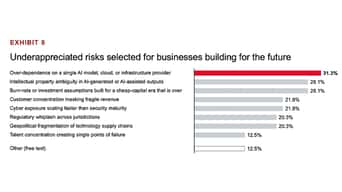
Two different risk questions broaden the discussion. The first asked respondents to select underappreciated risks facing businesses building for the future; the second asked for the single greatest resilience gap in their own business or portfolio over the next three years. Here, a resilience gap means a vulnerability that could reduce the business’s ability to withstand disruption. Because the questions ask different things and allow different numbers of selections, their percentages should not be treated as one combined measure.
For underappreciated risks, over-dependence on a single AI model, cloud, or infrastructure provider led at 31%. Intellectual property ambiguity in AI-generated or AI-assisted outputs and burn-rate or investment assumptions built for a cheap-capital era that is over each received 28%. These percentages indicate how often the offered risk descriptions were selected; they are not estimates of exposure, probability, severity, or loss.
For the greatest own-business or portfolio resilience gap, technology dependency led at 28%, followed by funding or capital-market shock at 20% and customer or revenue concentration at 13%. The complete answer space also includes regulatory, cyber, talent, infrastructure, and physical-risk concerns, as well as no major gap and Other.
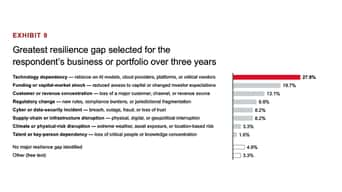
The technology-dependency options differ. The own-business or portfolio question includes platforms and critical vendors, permits only one choice, and specifies a three-year horizon. The general-risk question allows several concerns. Their percentages should not be pooled, subtracted as a change measure, or read as probabilities of loss.
A direct pairing makes the tension concrete. Of the 24 respondents who selected access to AI models or tooling as a weakening source of advantage, nine (38%) also selected reliance on a single AI model, cloud, or infrastructure provider as an underappreciated risk. Among the other 40 respondents, 11 (28%) selected that risk. Some respondents therefore saw both limited differentiation from access and a risk in dependence on a provider.
This pairing shows coexistence, not a strong relationship: the questions do not identify whether respondents had the same technology or provider in mind. Strategically, the useful point is that a capability can be widely available and still be operationally important. Azoulay, Krieger, and Nagaraj separately argue that control of complementary assets may shape entry and concentration in generative AI. That external argument provides context; it does not verify a mechanism in these answers.
Within-submission reading of Questions 6 and 10. Single-provider risk: 9/24 (37.5%) among AI-access-erosion selectors versus 11/40 (27.5%) among others. Different question frames; descriptive pairing, not a causal estimate.
Together, these responses suggest a broader management question: what does the business rely on, not just what makes it distinctive? A company can adapt quickly and still be vulnerable to a funding shock, concentration in a major customer, dependence on one technology provider, or a regulatory or cybersecurity event. Our survey does not establish causal relationships among those vulnerabilities, but it makes clear that defensibility and resilience extend beyond learning speed.
No single risk commanded a majority, and our survey did not test which mitigations work. The value of these questions is to surface vulnerabilities that leaders may want to examine alongside the sources of advantage.
Some apparently interesting subgroup differences became much smaller when we checked whether one group simply tended to select more options. This can happen mechanically: if Group A usually ticks three boxes in a multi-select question while Group B usually ticks only one, almost any individual option has more opportunities to appear in Group A.
In one exploratory comparison concerning the faster-replication threat, the raw difference between two groups was 17.9 percentage points. After re-expressing the comparison so that both groups had the same mix of respondents selecting one, two, or three-or-more options, the difference fell to 2.3 percentage points. Because the contrast largely disappeared under that check, we did not promote it as a headline finding.
In plain language, we asked whether the gap still looked roughly the same once both groups were given the same mix of response patterns. In this example, it did not. That does not prove response behavior caused the original difference or remove every other difference between the groups; it does show why an arithmetically correct contrast may still be too fragile to build a public story around.


Part of the Defensibility in the age of AI report, this excerpt considers how AI is reshaping the foundations of lasting competitive advantage.

Managing risk across multiple jurisdictions requires global coordination without losing sight of local requirements. Brian Grabek, Head of Multinational at Sompo, explains what makes an international insurance programme work.
Competitive advantage is only part of the picture. Our research examines the dependencies and concentration risks that can leave otherwise strong businesses exposed.

As AI makes products and capabilities easier to replicate, is faster adaptation enough? This excerpt examines the tension between speed and specialisation — and the questions leaders should test when considering what makes a business defensible.

How quickly could a well-funded competitor replicate the core of what customers buy? This excerpt from Defensibility in the Age of AI examines respondents’ estimates and the commercial advantages a competitor may still need to overcome.

Part of the Defensibility in the age of AI report, this excerpt considers how AI is reshaping the foundations of lasting competitive advantage.

As AI makes it easier to build and replicate products, leaders face a new challenge: how to sustain competitive advantage. This research explores what founders, investors, and business leaders believe will remain difficult to copy in the years ahead.

In this episode of Redefining Risk with Sompo, Matt Hoare and Cédric Wells explore what it takes to manage claims across borders - from coordinating global and local policies to navigating different regulations, cultures and market practices.

A packaging manufacturer needed a simpler way to manage casualty cover across 10 countries. See how Sompo combined multinational expertise and local insight to deliver a streamlined, consistent insurance solution.
We are Sompo, a global provider of commercial and consumer property, casualty, and specialty insurance and reinsurance. Building on the 138 years of innovation of our parent company, Sompo Holdings, Inc., Sompo employs approximately 10,000 people around the world who use their in-depth knowledge and expertise to help simplify and resolve your complex challenges. Because when you choose Sompo, you choose The Ease of Expertise™.
“Sompo” refers to the brand under which Sompo International Holdings Ltd., a Bermuda-based holding company, together with its consolidated subsidiaries, operates its global property and casualty (re)insurance businesses. Sompo International Holdings Ltd. is an indirect wholly-owned subsidiary of Sompo Holdings, Inc., one of the leading property and casualty groups in the world with excellent financial strength as evidenced by ratings of A+ (Superior) from A.M. Best (XV size category) and A+ (Strong) from Standard & Poor’s. Shares of Sompo Holdings, Inc. are listed on the Tokyo Stock Exchange.
To learn more please follow us on LinkedIn.