
Article
Speed, specialisation and strategic advantage in the AI era

Written by
Article details


Article
Written by
Article details


Why adapting faster is not, by itself, a complete answer to competition
If established advantages are under pressure and offerings may be replicated, faster adaptation is an understandable response. Our survey does not support reducing the strategy question to that single prescription.
The strategy question deliberately contrasted a company with a strong existing moat built on deep specialization with one whose moat was less established but whose speed of adaptation was greater. Respondents were asked which was more likely to remain defensible over the next three years. This is a specific trade-off: it does not compare two otherwise identical companies, and it does not test a third strategy of deliberately combining maximum specialization with maximum speed.
35% selected deep specialization, 26% selected greater adaptation speed, another 26% said the answer depended too much on the business model, product, or market to generalize, and 13% were unsure. Deep specialization received the largest share, but no answer commanded a majority. The finding is disagreement and context dependence rather than a consensus around speed.
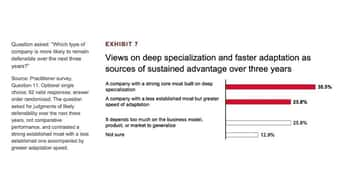
The free-text comments add perspectives rather than explanations for those percentages. Some respondents favor agility or continuing reinvention; one explicitly values both speed and domain expertise; another worries that short-term focus can displace long-term commitment and investment. Read together, the comments reinforce the absence of a simple one-variable answer.
One comment adds a useful reminder that some forms of advantage accumulate on a different timeline:
Building trust within teams and with customers takes time. It is not a straight line; there are ups and downs.
Survey response, quoted anonymously with permission; edited for readability.
The comment brings a different timeline into the discussion. Trust and relationships may depend on repeated interaction rather than a release schedule. That makes “what is our speed for?” a useful leadership question: what should faster learning or delivery help the business understand, improve, or retain? Our survey did not compare these accumulation times or test whether trust protects a business from displacement.
The implication for leaders is a resource-allocation question: which assumptions need to be tested quickly, and which forms of expertise or customer knowledge deserve sustained investment? Faster activity should have a stated purpose — something the business intends to understand, improve, or build — rather than being treated as an end in itself.
DO SHOW
The data do show divided practitioner judgments: no single answer commanded a majority, deep specialization received the largest share, and a substantial group said the answer depends on the business model, product, or market.
DO NOT ESTABLISH
What the data do not establish is that faster adaptation is superior, that combining specialization and speed necessarily produces better outcomes, or that learning speed can overcome every financial, technological, operational, or market vulnerability.
Considerations
The following questions translate the evidence into an inquiry for the business, not a prescribed strategy. Buyer access, customer value, economics, implementation, and dependencies are familiar disciplines. Their relevance here is to reconsider what each contributes when the core offering may be easier to reproduce and competitors may find different routes to the customer.
The replication estimates make this the first question to ask. Winning requires more than building something similar, and a rival may not need to reproduce every incumbent advantage if it can reach or serve customers differently. Our survey does not establish the conditions for displacement or show that AI has already made an alternative route viable; it makes those possibilities important to test in the specific business.
The comments raise the right buyer, evidence of value, market education, the difference between need and business viability, and what customer work can leave behind. Ask what an engagement teaches, what evidence it produces, and what can responsibly be reused. Those are propositions to test in the business, not universal success factors established by this survey.
The divided judgments make “specialization or speed” too coarse a company-wide choice. Identify where expertise, accumulated knowledge, trust, or technical depth creates value and where routines, products, or assumptions need to change. Then ask what faster work should build: better customer understanding, stronger evidence, more effective integration, or capabilities the business can retain. The aim is purposeful adaptation; our survey does not establish an optimal mix or prove that speed produces compounding advantage.
The two risk questions show why an attractive offering is not enough. A business can retain customer value and still be weakened by concentration, dependency, or external shocks. The relevant task is to identify which dependencies are material in the specific business and how they would be detected, tested, and mitigated.
The responses capture judgments made from 5 June to 23 August 2026. They are a record of that period, not a permanent account of how competitive advantage works. One respondent noted that newer AI versions had already made earlier assessments of possible applications feel inadequate. That comment does not establish an objective rate of change, but it captures why a time stamp is useful in research on fast-moving technology.
When interpreting the snapshot, it helps to separate three things: changes in AI capability; changes in the cost and practicality of applying those capabilities; and the business consequences that may follow. A capability becoming technically possible is not the same as its becoming economical or reliable in a particular setting, and neither automatically determines how customers, products, business models, competitive structures, or company performance will change.
Those business consequences may also be indirect. A company may encounter them through different choices made by a customer, supplier, or competitor rather than through its own adoption of AI. Some consequences may appear quickly; others may take years to work through products, customer behavior, business models, and company performance.
Our survey does not provide a fixed timetable for those effects or a forecast of when displacement will occur. Its value as a time-stamped snapshot is different: it creates a record that can be revisited to see which practitioner judgments remained useful, which assumptions proved durable, and which were overtaken by events.
Further research could make several distinctions sharper. First, matched questions could compare the replication horizon of a respondent’s own offering with comparable offerings in the market, using the same scenario and time bands. That would permit a comparison the present questionnaire cannot make.
Second, future work could revisit these judgments prospectively and distinguish estimated replication from observed copying, entry, customer acquisition, switching, and displacement. A broader response set, including more investors and later-stage businesses, could test whether the strongest founder/operator contrast recurs and whether it survives comparable selection-count checks.
Third, the bypass hypothesis could be tested directly: can a competitor serve the same customer need through a different business model, channel, or cost structure without reproducing the incumbent’s assets? Further research could also distinguish capabilities an organization can acquire from those it develops through experience, and examine whether customer work actually produces reusable evidence, data, integration knowledge, or relationships. Acquired and accumulated advantages are useful concepts to investigate, not a taxonomy validated by this survey.
These are open questions suggested by the findings, not a commitment to a future study or a forecast of its results.
Download the full report below.


Part of the Defensibility in the age of AI report, this excerpt considers how AI is reshaping the foundations of lasting competitive advantage.

Managing risk across multiple jurisdictions requires global coordination without losing sight of local requirements. Brian Grabek, Head of Multinational at Sompo, explains what makes an international insurance programme work.

Competitive advantage is only part of the picture. Our research examines the dependencies and concentration risks that can leave otherwise strong businesses exposed.

As AI makes products and capabilities easier to replicate, is faster adaptation enough? This excerpt examines the tension between speed and specialisation — and the questions leaders should test when considering what makes a business defensible.

How quickly could a well-funded competitor replicate the core of what customers buy? This excerpt from Defensibility in the Age of AI examines respondents’ estimates and the commercial advantages a competitor may still need to overcome.

Part of the Defensibility in the age of AI report, this excerpt considers how AI is reshaping the foundations of lasting competitive advantage.

As AI makes it easier to build and replicate products, leaders face a new challenge: how to sustain competitive advantage. This research explores what founders, investors, and business leaders believe will remain difficult to copy in the years ahead.

In this episode of Redefining Risk with Sompo, Matt Hoare and Cédric Wells explore what it takes to manage claims across borders - from coordinating global and local policies to navigating different regulations, cultures and market practices.

A packaging manufacturer needed a simpler way to manage casualty cover across 10 countries. See how Sompo combined multinational expertise and local insight to deliver a streamlined, consistent insurance solution.
We are Sompo, a global provider of commercial and consumer property, casualty, and specialty insurance and reinsurance. Building on the 138 years of innovation of our parent company, Sompo Holdings, Inc., Sompo employs approximately 10,000 people around the world who use their in-depth knowledge and expertise to help simplify and resolve your complex challenges. Because when you choose Sompo, you choose The Ease of Expertise™.
“Sompo” refers to the brand under which Sompo International Holdings Ltd., a Bermuda-based holding company, together with its consolidated subsidiaries, operates its global property and casualty (re)insurance businesses. Sompo International Holdings Ltd. is an indirect wholly-owned subsidiary of Sompo Holdings, Inc., one of the leading property and casualty groups in the world with excellent financial strength as evidenced by ratings of A+ (Superior) from A.M. Best (XV size category) and A+ (Strong) from Standard & Poor’s. Shares of Sompo Holdings, Inc. are listed on the Tokyo Stock Exchange.
To learn more please follow us on LinkedIn.