
Article
Replication is not displacement: What competitors still need to win customers

Written by
Article details


Article
Written by
Article details


How quickly respondents think a competitor could copy the core of what customers buy
Our survey asked how quickly a well-funded competitor could replicate the core product or service proposition that respondents offer, or that their best portfolio company offers. In that hypothetical scenario, respondents estimated the time required to reproduce the core of an offering. The question did not ask them to forecast a competitor’s actual plans or estimate how long it would take to reproduce the entire business.
58% estimated that replication could occur within two years, including 30% who placed the horizon at twelve months or less.
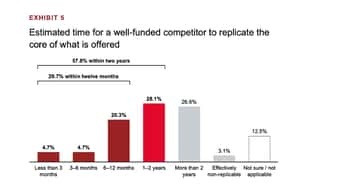
The remaining responses temper the headline: 27% estimated more than two years, 3% selected effectively non-replicable, and 13% were unsure or considered the question inapplicable. Those uncertain answers remain in the denominator for the primary result. The finding therefore describes a distribution of expectations, not a consensus that every offering can be copied quickly.
A separate question asked about the greatest threats to durable competitive advantage in respondents’ markets over the next three years. Faster replication by competitors was selected by 58%. The identical percentage arises from two different measures: selecting a market threat is not the same as estimating the replication time of a particular offering, and the respondent groups only partly overlap.
Among the 37 respondents selecting faster replication as a market threat, nine (24%) estimated that their own or best portfolio company’s core offering would take one to two years to replicate, and 11 (30%) estimated more than two years. Together, that is 20 of 37 (54%). Another 12 (32%) estimated twelve months or less, while five (14%) were unsure or considered the question inapplicable.
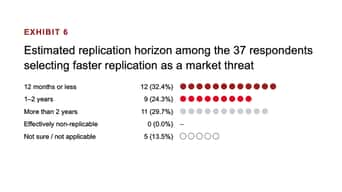
There is no contradiction between these answers. A respondent may see replication as a significant market threat while believing that a particular offering still gives the business some time to respond. Our survey did not ask for a market-wide replication horizon against which to compare the own-offering estimate, so the useful follow-up is practical: what makes the estimated window credible, and how will the business use it?
Being able to replicate an offering is not the same as being able to displace the business that provides it.
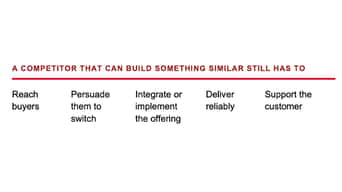
The estimated replication horizon can be useful in a planning discussion, but it leaves major competitive questions unanswered. A competitor that can build something similar still has to reach buyers, persuade them to switch, integrate or implement the offering, deliver reliably, and support the customer. Our survey did not measure how long it would take to reproduce trust, relationships, distribution, implementation capability, or accumulated knowledge — nor whether those advantages would be enough to protect an incumbent if the core offering itself could be reproduced.
If replicability is only one part of defensibility, what else should leaders examine?
The optional lessons question asked for the most important insight about building or sustaining competitive advantage that respondents wished they had known earlier. It invited reflection rather than an explanation of the structured answers. We therefore read the free-text comments as lessons, counterpoints, and possible explanations to investigate — not as causes of the percentages.
The comments point to several distinct commercial problems: reaching a buyer with the authority and budget to purchase; demonstrating enough value to justify that purchase; showing that customer need can support a viable business model; understanding the customer’s problem and helping the customer understand the offering; adapting implementation, integration, or onboarding to the customer’s environment; building relationships with customers and partners; and retaining evidence and know-how from work already completed.
These themes are neither a ranking nor a validated sequence of success factors. They identify commercial work beyond a comparable product without establishing which conditions prevent displacement.
Founders and senior startup operators often located their strongest current advantage in technical depth: 38% selected deep technical or scientific intellectual property. That is compatible with the commercial lessons in their comments. What currently distinguishes an organization is a different question from what someone wishes they had understood earlier about building it.
Within-submission reading of technical-IP selections and lessons comments brings these perspectives together: respondents could value technical depth while emphasizing market education, the work surrounding pilots, or the difficulty of competing with established trust and scale. Those comments do not show that their intellectual property failed. They suggest asking what must surround technical strength for customers to adopt it and for the business to retain value.
One respondent, writing in the context of the insurance industry, argued that speed to market is useful only if the company has identified the right buyer and the right market. Another emphasized clear use cases, a credible return-on-investment argument, and the continued nurturing of relationships. These are distinct commercial tasks: reaching someone able to buy is different from demonstrating that a purchase is worthwhile, and a persuasive return-on-investment case is different from evidence that those returns have actually been realized.
A particularly concise response separated customer need from business viability:
The fact that there is a need does not mean there is a business.
Survey response, quoted anonymously with permission; capitalization and punctuation edited for readability.
That observation sharpens a specific commercial question: what would make this particular offering economically viable, rather than merely useful or desirable? Our survey did not examine the economics of respondents’ businesses, so the comment cannot tell us which business models will work. It does, however, expose a distinction that product-focused discussions can easily blur.
Several free-text comments focused on the work required for customers to understand and adopt an offering. One respondent described market education as often a bigger challenge than product development; another emphasized understanding customer problems and integration requirements. Those comments suggest asking what the customer must understand, and what may need to change in implementation, integration, onboarding, or delivery, before a technically capable offering can be used successfully.
One practitioner offered a specific proposition about pilot design:
We wish we had understood earlier that every pilot should be designed not only to demonstrate technical performance, but also to generate reusable data, measurable evidence, implementation know-how, and deeper customer relationships.
Survey response, quoted anonymously with permission; excerpt.
The respondent is describing a desired pilot outcome rather than reporting a demonstrated causal mechanism. That makes the comment useful as a design question: how can a technical lead be converted into reusable evidence, implementation know-how, data, or relationships before competitors catch up?
Customer work might, subject to applicable contractual, confidentiality, intellectual property, data protection and other legal requirements, generate reusable evidence, implementation know-how or data, as well as deeper customer relationships. Evidence from one engagement might help another buyer assess a claim; knowledge from a deployment might make later implementation easier; repeated delivery might build trust. The strategic proposition is to use a technical lead to build something valuable beyond the immediate output. Whether those benefits arise, can be reused, or become difficult for competitors to match remains untested here. Our survey did not observe sales conversion, delivery costs, retention, or the performance of businesses that accumulated more of them.
A respondent writing about the insurance industry complicates the idea that an attractive technical offering is enough to win:
Especially for insurance buyers, brand trust and sheer size are very hard to compete with as a startup
Survey response, quoted anonymously with permission; excerpt.
Insurance is highly regulated and capital-intensive, while a major part of the product’s value is experienced when a customer suffers a loss and needs the insurer to perform. Brand, trust, financial strength, and scale can therefore carry particular weight. This remains one respondent’s view of the difficulty a startup may face against established providers, not a result about every market. Together with the earlier comment about the difficult work of producing an intuitive user experience, it is a reminder that technical and non-technical advantages can matter at the same time.
Our survey did not compare how long it takes to reproduce these different sources of advantage. Trust, knowledge, and relationships may matter without guaranteeing that a customer will stay.
The insurance context may be particularly relevant given the regulatory and capital requirements applicable to insurers and the importance customers may attach to an insurer's ability to meet claims. These factors may contribute to the importance of brand, trust and financial strength, although the survey did not test that proposition.
A competitor may not need to reproduce every advantage an incumbent has built. AI could change the economics of activities such as analysis, customization, experimentation, software development, and service delivery enough to make a different route to the customer viable — for example, through a different operating model, channel, degree of customization, or cost structure. The logic resembles technological leapfrogging: adopting mobile phones does not require first reproducing a mature fixed-line telephone network. A competitor may similarly make an incumbent advantage less relevant rather than rebuild it.
Bypass is a hypothesis prompted by the research, not a survey result. Our survey did not measure changes in those costs, the viability of alternative routes to market, customer switching, or displacement. It invites a broader question: must a rival reproduce the incumbent’s assets and processes, or could it make some of them less relevant by serving customers differently?
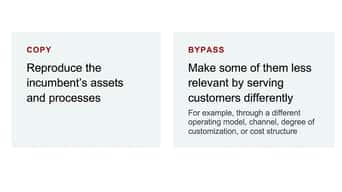
The resulting inquiry is broader than whether a competitor can build something similar. What must it actually do to win and serve customers, and which incumbent advantages would it need to reproduce, neutralize, or bypass? That framing leaves room for both enduring constraints and genuinely different ways of competing without assuming either outcome in advance.
Download the full report below.


Part of the Defensibility in the age of AI report, this excerpt considers how AI is reshaping the foundations of lasting competitive advantage.

Managing risk across multiple jurisdictions requires global coordination without losing sight of local requirements. Brian Grabek, Head of Multinational at Sompo, explains what makes an international insurance programme work.

Competitive advantage is only part of the picture. Our research examines the dependencies and concentration risks that can leave otherwise strong businesses exposed.

As AI makes products and capabilities easier to replicate, is faster adaptation enough? This excerpt examines the tension between speed and specialisation — and the questions leaders should test when considering what makes a business defensible.

How quickly could a well-funded competitor replicate the core of what customers buy? This excerpt from Defensibility in the Age of AI examines respondents’ estimates and the commercial advantages a competitor may still need to overcome.

Part of the Defensibility in the age of AI report, this excerpt considers how AI is reshaping the foundations of lasting competitive advantage.

As AI makes it easier to build and replicate products, leaders face a new challenge: how to sustain competitive advantage. This research explores what founders, investors, and business leaders believe will remain difficult to copy in the years ahead.

In this episode of Redefining Risk with Sompo, Matt Hoare and Cédric Wells explore what it takes to manage claims across borders - from coordinating global and local policies to navigating different regulations, cultures and market practices.

A packaging manufacturer needed a simpler way to manage casualty cover across 10 countries. See how Sompo combined multinational expertise and local insight to deliver a streamlined, consistent insurance solution.
We are Sompo, a global provider of commercial and consumer property, casualty, and specialty insurance and reinsurance. Building on the 138 years of innovation of our parent company, Sompo Holdings, Inc., Sompo employs approximately 10,000 people around the world who use their in-depth knowledge and expertise to help simplify and resolve your complex challenges. Because when you choose Sompo, you choose The Ease of Expertise™.
“Sompo” refers to the brand under which Sompo International Holdings Ltd., a Bermuda-based holding company, together with its consolidated subsidiaries, operates its global property and casualty (re)insurance businesses. Sompo International Holdings Ltd. is an indirect wholly-owned subsidiary of Sompo Holdings, Inc., one of the leading property and casualty groups in the world with excellent financial strength as evidenced by ratings of A+ (Superior) from A.M. Best (XV size category) and A+ (Strong) from Standard & Poor’s. Shares of Sompo Holdings, Inc. are listed on the Tokyo Stock Exchange.
To learn more please follow us on LinkedIn.