

Article
Defensibility in the age of AI: Rethinking competitive advantage

Written by
Article details


Article
Written by
Article details


For decades, businesses have relied on combinations of expertise, proprietary data, distribution, regulation, trust, relationships, switching costs, and scale to make competitive positions harder to reproduce.
None of these advantages was ever permanent, but many demanded time, access, capital, or accumulated organizational learning. Rapidly advancing generative AI raises a sharper question: which of these advantages remain difficult to reproduce, and which can be challenged more quickly?
“Can it be built?” asks whether a business can create an offering. “Can it be kept?” asks whether it can sustain the resulting advantage for a strategically relevant period. Here, “building” also includes maintaining, refining, and extending an existing offering. The question therefore applies as much to an established organization improving what it already sells as to a startup launching something new. Building a comparable product, delivering it, winning customers, and displacing the provider remain different competitive problems.
We began the inquiry in June 2025 with a hypothesis that increasingly capable and accessible AI might put pressure on some established sources of advantage, especially visible product features and mere access to technology. This question sits alongside a long tradition of strategy research. The resource-based view emphasizes resources that are valuable, scarce, and difficult to imitate or substitute.
Dynamic-capabilities research examines how firms reconfigure assets and processes as conditions change. Our narrower question was whether rapidly diffusing generative AI could alter the replicability, scarcity, or relative importance of particular advantages.
Recent empirical work provides a different kind of context. Noy and Zhang studied generative AI on professional writing tasks and reported productivity gains in that setting. Brynjolfsson, Li, and Raymond examined an AI assistant in customer support and also reported productivity benefits. Task performance is not the same outcome as enduring competitive advantage: faster or better work may change competitive conditions without determining which firm captures the value.
Around June 2025, prominent public offerings included OpenAI’s GPT-4.1, Anthropic’s Claude 4 family, and Google’s Gemini 2.5 family. By 2026, another generation of frontier models had arrived, including GPT-5.6 and Claude Opus 5.5. The point is not model genealogy. It is that the technical baseline moved materially during the life of the inquiry.
Other developments reinforced the same point from different directions. In September 2026, OpenAI announced an AI-assisted result on the Navier–Stokes Millennium Prize Problem. In August, it reported a cybersecurity incident arising from July internal evaluations conducted with reduced safeguards. In June, Anthropic reported suspending access to Fable 5 and Mythos 5 after a US government directive and later restoring access after the controls were lifted. Capability, containment, and access governance were all moving over the life of the inquiry; none of these events, by itself, demonstrates erosion of a particular business advantage.
This is why we sought the judgment of practitioners: people directly involved in building, operating, backing, or evaluating businesses and technologies. Their views can identify perceived pressures, disagreements, and questions worth investigating. They complement — rather than replace — evidence from observed company, customer, and competitor behavior over time.
Our 64 completed submissions were received from 5 June to 23 August 2026. This is the period represented by the responses, rather than the later administrative closure date. Our survey was self-selected and was not designed to be statistically representative. Detailed information on recruitment, identity verification, denominators, anonymity, and evidence handling appears in the methodology section.
Respondents were deliberately asked to answer at a general level and not to disclose confidential, proprietary, commercially or competitively sensitive, or third-party information. Our study therefore sought broad practitioner judgment rather than detailed proprietary company case studies.
Responses are reported anonymously, and only comments for which explicit permission was given are eligible to appear as quotations. The methodology section explains how optional contact information, identifiers, and quotation permissions were handled.
The report moves from current sources of advantage to perceived weakening, estimated copying times, the commercial work beyond a product, and the limits of a speed-only response. It then brings the main tensions together, poses questions for leaders, and closes with questions the research leaves open. The methodology explains how the responses were analyzed and checked.
Before examining pressure on competitive advantage, it helps to understand where respondents currently locate it. Our survey asked for the single strongest source in their own organization and, separately, the strongest source in their market.
For their own organization, the most frequent choices were deep technical or scientific intellectual property (22%) and brand and trust (21%). At market level, distribution and partnerships led at 20%. The complete distributions follow so that the leading choices can be read alongside the alternatives.
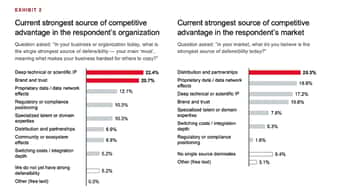
These two results answer different questions. The organization question asks respondents to choose the single source that most distinguishes their own organization; the market question asks which source is strongest in the market more generally. The answer lists and valid response counts also differ. The results therefore should not be read as evidence that advantage has shifted from one source to another, or that organizations are “underinvesting” in a category simply because it is selected more often at market level.
Choosing a single strongest source does not mean that the organization lacks the others. The answer choices also do not map exactly across the two questions: the organization question includes community or ecosystem effects and an option for not yet having strong defensibility, while the market question includes “No single source dominates.” A category that was not offered in one question must not be treated as though respondents selected it zero times.
A respondent can identify an advantage as the strongest source in an organization today and still believe that it has become less reliable over the previous two to three years. Relative strength today and perceived change in reliability are different judgments, not two ends of a single scale.
Pure feature differentiation and access to AI models or tooling were the most frequently selected sources of advantage becoming less reliable. Asked about the previous two to three years in their business or organization, 42% selected pure feature differentiation and 38% selected access to AI models or tooling.
Access to an AI model is not the same as the ability to apply it effectively, and visible product features are not the same as deep technical or scientific intellectual property. These answers describe perceived reliability rather than changes in revenue, profit, or market position. The finding is therefore narrow but useful: respondents expressed concern about two particular sources of advantage, not about technology-based differentiation as a whole.
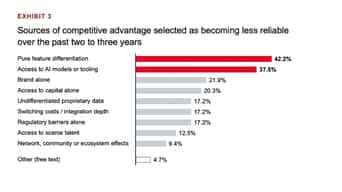
Question 6 required respondents to select between one and three sources and did not offer a “none” option. It therefore shows which sources were most often identified as becoming less reliable; it does not tell us what proportion of respondents believed defensibility had weakened overall.
A source selected less often is not thereby proven durable: a respondent may not possess it, may not rely on it, or may have used the available selections for other concerns.
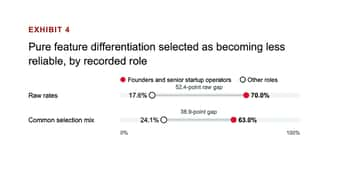
Pure feature differentiation was selected by 70% of founders and senior startup operators, compared with 18% of respondents in other roles. This is a large descriptive difference in the response set; the comparison group includes several different roles, not investors alone.
Founders and startup operators also tended to select more options on this question. When both groups were re-expressed using the same mix of one-, two-, and three-option respondents, the gap fell from about 52 to 39 percentage points. Selection behavior therefore affects the size of the contrast but does not erase it. The founder/operator group was also much more concentrated in pre-seed and seed businesses, so role and company stage remain intertwined.
Within this sample, founders and startup operators were substantially more likely to report weakening feature differentiation. Because role and company stage are entangled, this is a pattern to test again rather than an estimate of the wider founder population.
The respondents’ free-text comments, when provided, also push against the idea that all technology-related differentiation is becoming interchangeable. One respondent focused on the difficult work of designing and refining a product so that it is genuinely intuitive and satisfying to use:
A clean, intuitive user interface is still a moat and really hard to replicate.
Survey response, quoted anonymously with permission; lightly edited for readability.
This judgment qualifies, rather than contradicts, the concern about weakening feature differentiation. A source of advantage can come under pressure without every instance becoming easy to reproduce or losing all value.
Other free-text comments described AI as something that could strengthen capabilities rather than merely commoditize them. Two respondents put that possibility directly:
AI should be used to collect and share employees’ experiences and skills.
Survey response, quoted anonymously with permission; edited for readability.
There is no alternative to deep domain expertise and technical capabilities. AI combined with both of these factors is the game changer.
Survey response, quoted anonymously with permission; lightly edited for grammar and readability.
These comments separate access to a tool from the organizational ability to combine it with experience, domain expertise, and technical capability. Our survey does not measure the performance effect of those combinations; it does show that respondents did not treat simple access and effective application as the same thing.
Taken together, the structured answers and contrasting comments support a precise conclusion: feature differentiation and mere access to AI are perceived pressure points in this response set, while technology-related differentiation can still arise from how capabilities are designed, combined, and applied.
Download the full report below.


How quickly could a well-funded competitor replicate the core of what customers buy? This excerpt from Defensibility in the Age of AI examines respondents’ estimates and the commercial advantages a competitor may still need to overcome.

Managing risk across multiple jurisdictions requires global coordination without losing sight of local requirements. Brian Grabek, Head of Multinational at Sompo, explains what makes an international insurance programme work.

Competitive advantage is only part of the picture. Our research examines the dependencies and concentration risks that can leave otherwise strong businesses exposed.

As AI makes products and capabilities easier to replicate, is faster adaptation enough? This excerpt examines the tension between speed and specialisation — and the questions leaders should test when considering what makes a business defensible.

How quickly could a well-funded competitor replicate the core of what customers buy? This excerpt from Defensibility in the Age of AI examines respondents’ estimates and the commercial advantages a competitor may still need to overcome.

Part of the Defensibility in the age of AI report, this excerpt considers how AI is reshaping the foundations of lasting competitive advantage.

As AI makes it easier to build and replicate products, leaders face a new challenge: how to sustain competitive advantage. This research explores what founders, investors, and business leaders believe will remain difficult to copy in the years ahead.

In this episode of Redefining Risk with Sompo, Matt Hoare and Cédric Wells explore what it takes to manage claims across borders - from coordinating global and local policies to navigating different regulations, cultures and market practices.

A packaging manufacturer needed a simpler way to manage casualty cover across 10 countries. See how Sompo combined multinational expertise and local insight to deliver a streamlined, consistent insurance solution.
We are Sompo, a global provider of commercial and consumer property, casualty, and specialty insurance and reinsurance. Building on the 138 years of innovation of our parent company, Sompo Holdings, Inc., Sompo employs approximately 10,000 people around the world who use their in-depth knowledge and expertise to help simplify and resolve your complex challenges. Because when you choose Sompo, you choose The Ease of Expertise™.
“Sompo” refers to the brand under which Sompo International Holdings Ltd., a Bermuda-based holding company, together with its consolidated subsidiaries, operates its global property and casualty (re)insurance businesses. Sompo International Holdings Ltd. is an indirect wholly-owned subsidiary of Sompo Holdings, Inc., one of the leading property and casualty groups in the world with excellent financial strength as evidenced by ratings of A+ (Superior) from A.M. Best (XV size category) and A+ (Strong) from Standard & Poor’s. Shares of Sompo Holdings, Inc. are listed on the Tokyo Stock Exchange.
To learn more please follow us on LinkedIn.